S1 Training Document
Document Identification
| Type | Training Material |
| Version | 1.0 |
| Issue Date | 15th August 2024 |
| Effective Date | 15th August 2024 |
Revision Records
| Revision | Date | Description of Change | Author |
|---|---|---|---|
| 1.0 | 15th August 2024 | Initial draft | Amir G. |
Purpose
This document is published for the purpose of S1 Training. This Guideline shall be adhered to by all Iran vACC resident controllers.
This document is only used for VATSIM Virtual ATC training purposes. DO NOT use this document for Real World ATC training or whatsoever. VATSIM Iran vACC shall NOT be held responsible and accountable for the usage of this document in all Real-World ATC training and Real-World Flying Activities.
Delivery Controller Responsibilities
- Mainly responsible for: a. Issuing correct ATC Clearances for departing aircraft. b. Ensure pilots acknowledge and readback the clearance given correctly.
- Any incorrect or incomplete readback shall be corrected promptly prior to releasing aircraft to the next controller, which is ground or in the absence of ground, any other higher controlling position in charge of the aerodrome (if online). If necessary, shall also perform coordination for level allocation with adjacent ATC units or stations.
- If there is no higher ATC position available, controllers shall release the aircraft to UNICOM Frequency after receipt of ATC Clearance.
- Maximum visibility range settings is 20 NM in Euroscope connection settings.
ATC Clearances
A general definition of an ATC Clearance is an authorization by an Air Traffic Control Unit for an aircraft to proceed under conditions specified by that unit. As a delivery controller, you may issue a clearance directly to the aircraft. ATC Clearance must be issued early enough to ensure that they are transmitted to the aircraft in sufficient time for compliance.
Pilot Requirements for ATC Clearance
- A pilot is required to obtain ATC Clearance prior to operating an IFR or VFR flight in Class A, B, C and D airspace. The pilot shall request such clearance from the Delivery Controller through either voice or text. A flight plan shall be filed before a pilot can request for a clearance.
- If an ATC Clearance is not satisfactory to the Pilot-In-Command (PIC) or in his opinion would endanger his aircraft, he/she may request for an alternative clearance.
- Delivery controller may, if practicable, issue an amended clearance. The PIC shall readback in full, to all parts of ATC Clearances and instructions which are transmitted by voice or text. By giving a complete readback of an ATC Clearance, a PIC is deemed to have understood and is able to comply with clearance.
Delivery Controller Procedures
- When issuing ATC Clearance, Delivery Controller shall ensure the clearance will ensure separation between aircraft in accordance with approved standards. The controller shall listen carefully to the readback to make sure that the clearance or instruction has been correctly acknowledged and understood by PIC and shall take immediate action to correct any incorrect readbacks.
- Delivery Controller shall always ensure proper, full and accurate readbacks when a clearance has been issued. Partial or incomplete readbacks are unacceptable and Controller must endeavor to ensure full readback from PICs.
- If controllers are doubtful about whether or not the pilot understands the clearance, please ask them if they understand it or if they are able to accept the clearance. If they are unable to accept or do not understand it, consider issuing an alternative clearance.
- Controller must check the RFL (Requested Flight Level), SID (Standard Instrument Departure), RWY (Runway), CFL (Cleared Flight Level/Initial Altitude) and ASSR (Squawk Number) on Departure List prior to giving the clearance.
a. If it is required, controller shall change SID, RWY, CFL and ASSR accordingly.
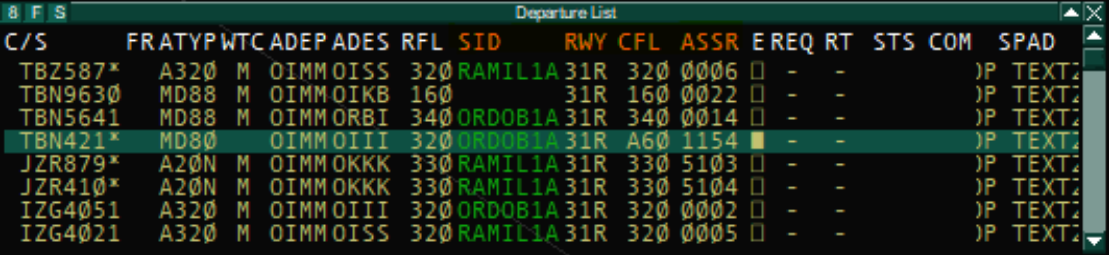
- Controllers are also required to click on the box under E column only after the pilot reads back the clearance correctly.
IFR ATC Clearance
Standard clearances for departing IFR aircraft shall contain the following items:
- Aircraft Identification (Callsign)
- Clearance Limit (Normally destination aerodrome)
- Assigned SID (if applicable)
- Initial climb level
- Assigned SSR Transponder Code (Squawk)
- Any other necessary instructions or information not contained in the SID Description, e.g.: departure frequency...
Examples:
TBN421 cleared to Tehran FL320 as filed, ORDOB1A departure, runway 31R, initial climb 6000ft, squawk 1154.TBN421 cleared to Tehran as filed via ORDOB1A departure, RWY 31R, initial climb 6000ft, departure frequency 127.300, squawk 1154.
ATC Clearance for VFR Flight
Before issuing ATC Clearance to VFR aircraft, Controller must ensure that the VFR flights are:
- Not operating in Class A airspace (FL200+)
- Between the hours of sunrise and sunset. (Can be waived on VATSIM as not all PICs fly in real time)
- Under Visual Meteorological Conditions (VMC) (Can be waived on VATSIM as not all PICs fly in real weather)
Examples:
EP-TBA, cleared for left hand downwind circuit runway 29L, 1000 feet, squawk 7000.EP-TBA, cleared to Payam, VFR as filed, squawk 7000.EP-TBA, cleared to leave CTR boundary enroute to Payam VFR direct, 6000 ft, squawk 7000.
Special VFR Clearance
- Special VFR is defined as "a controlled VFR flight authorized by ATC to operate within a control zone under meteorological conditions below the visual meteorological conditions".
- Special VFR is intended to afford greater freedom of movement to pilots who are unable to comply with IFR.
- Special VFR flights may be authorized under the following circumstances: a. Specifically requested by PIC b. PIC is not able to comply with IFR c. If authorisation for Special VFR is approved, it shall not interfere with or delay IFR flights d. Visibility is not less than 1500 meters
- Delivery controllers MUST take note to inform other units above them (ADC/APP/ACC) that a special VFR flight is in operation.
- Example
a.
EP-TBA, cleared Special VFR not above 7000 feet, squawk 7000.
The Quadrantal and Semi-Circular Rule
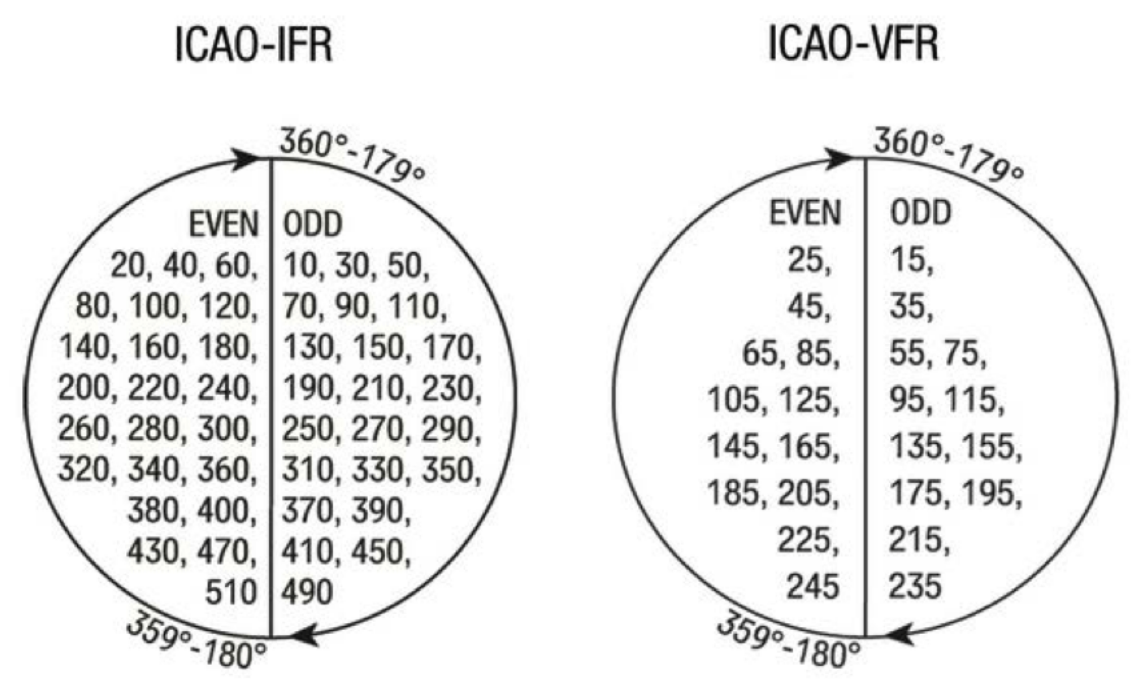
- The Semi-Circular Cruising Levels shall apply to all IFR & VFR flights leaving into controlled and uncontrolled (UNICOM) airspace.
- Controllers shall ensure that all levels filed by PICs during ATC Clearance Request comply with the flight level rule.
- If PIC files an incorrect cruise level with regards to the Semi-Circular Rule, controllers shall NOT issue ATC Clearance but rather, advise PIC that their requested cruise level is invalid.
- After that, advise PICs of available alternate levels (usually to the nearest 1000ft). For example, FL260 eastbound is not valid. Controllers may suggest either FL250 or FL270.
Traffic Orientation Scheme
- Iran vACC has a couple of standard routings with neighboring vACCs. Delivery controllers must make sure the PICs filed the correct standard routing. The route checker plugin takes care of this.
Initial Climb Altitude
- Major airports initial altitudes:
| Station | ICAO | Altitude (feet) |
|---|---|---|
| Tehran-Mehrabad | OIII | 7000 |
| Tehran-Imam Khomeini | OIIE | 7000 |
| Shiraz | OISS | 9000 |
| Isfahan | OIMM | 6000 |
| Mashhad | OIFM | 7000 |
| Ahvaz | OIAW | 3000 |
| Tabriz | OITT | 7500 |
| Rasht | OIGG | 3000 |
| Kermanshah | OIKB | 3000 |
| Bushehr | OIBK | 3000 |
Ground Controller Responsibilities
- A Ground Controller shall be responsible in managing as follows: a. Any ground movement (Fixed-wing and Rotary-wing) b. Aircraft Start-Up and Pushback c. Aircraft taxiing towards runways or parking bays d. Aircraft repositioning (E.g.: maintenance hangar to gate and vice versa) e. Preventing collision between aircraft on manoeuvring area
- Basic Aerodrome Layout:
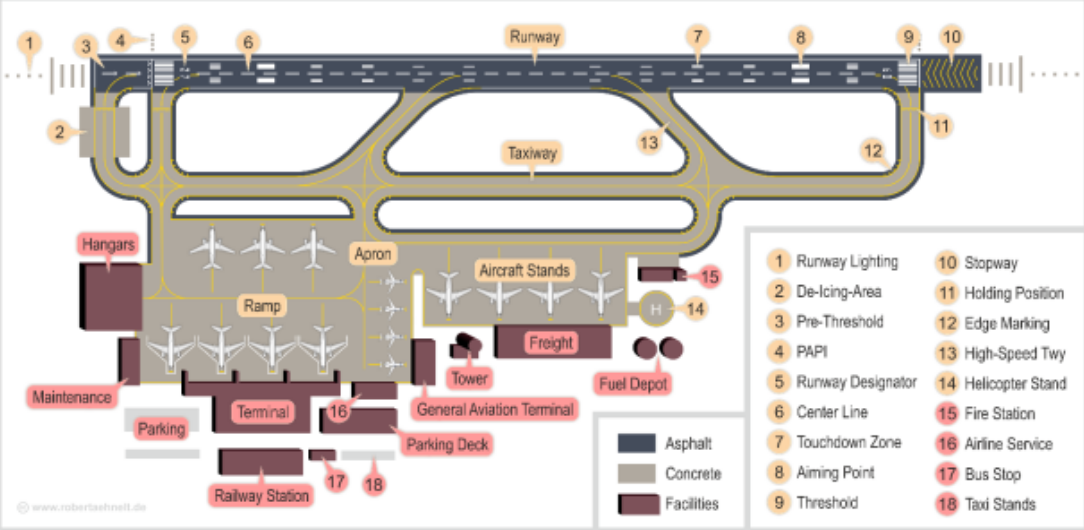
- The above is an example of a basic aerodrome layout. Ground controller are responsible for all traffic movement on the taxiway, apron, and parking bay areas. Certain aerodrome procedure requires aircraft to be transferred to tower before entering the main parallel taxiway.
- Prior to departure, the departing aircraft must be transferred to a higher ATC unit (if online) either at a pre-determined point or as coordinated. If no higher ATC unit is available, the aircraft shall be released to UNICOM.
- Controllers shall NOT control traffic beyond their respective jurisdiction area. Failure to adhere to this clause shall be considered a direct violation of VATSIM and Iran vACC controller behavior policy.
Pushback and Start-Up
- Pushback: Pilot shall call ground and request for pushback and start up clearance. Before granting pushback clearance, ground controller shall ensure:
a. Aircraft is squawking the assigned squawk code
b. Update aircraft ground status to
PUSH, ES will automatically update the sequence number c. Aircraft is not blocking or potentially causing head-on conflict with nearby traffic while commencing pushback - Start Up: It is important to note that not all aircraft will require pushback depending on the aircraft type and the parking bay configuration. This is most commonly seen at parking bays that is in a PIPO (Power In Power Out) configuration where pushback is not required. In that case, ground controller shall ensure that:
a. The squawk numbers are tally on both sides according to the auto-assigned squawk numbers by ES.
b. Update aircraft ground status to
ST-UP, ES will then automatically update the sequence number.
Taxi Clearance
- The term 'taxi' refers to aircraft's movement on the ground after finished pushback or after vacating the active runway. Ground controllers shall provide aircraft with taxi instructions to their parking bay.
- At certain airports, there are standard published taxi routes which are designed to prevent conflict between arrival and departing aircraft. Ground controllers may issue these standard routes to minimize workload.
- Ground controllers are responsible for making sure that pilots follow the issued taxi instructions correctly. In case of traffic congestion, ground controller shall coordinate with tower controller for traffic planning to ease the traffic flow.
- Situation Example 1 (taxi for departure):
a.
IRA671, taxi to holding point Runway 29R via standard route, QNH 1007.b.IRA671, taxi to holding point Runway 29R via J, A, N, QNH 1007. - Situation Example 2 (taxi for arrival):
a.
IRA671, taxi to stand 114 Left Z, A, G. - Situation Example 3 (hold position):
a.
IRA671, hold current position, give way to traffic (aircraft type) crossing from left to right. - Situation Example 4 (rotor wing):
a.
Police Chopper 02, air taxi to main apron for dispersal. - It is crucial to issue taxi clearance progressively short and precise. This is to ensure that pilots are able to understand much easier and avoid unnecessary repeating of clearance. When issuing taxi instructions, ground controller shall ensure that: a. The subject aircraft's taxi path does not potentially cause collision with surrounding traffic. b. Pilots readback the taxi instructions correctly. c. Pilots taxiing correctly according to the taxi route given. d. Pilots stop at holding points or taxi clearance limits given.
Transfer to Tower Controller
- A Ground controller's jurisdiction ends at runway holding point or at particular area defined as control boundary.
- As aircraft approaches the control boundary, ground controller shall release the aircraft to tower controller or next higher available ATS unit.
- If there are no further ATS unit available at that time, ground controller shall release the aircraft to UNICOM frequency.
END OF DOCUMENT